
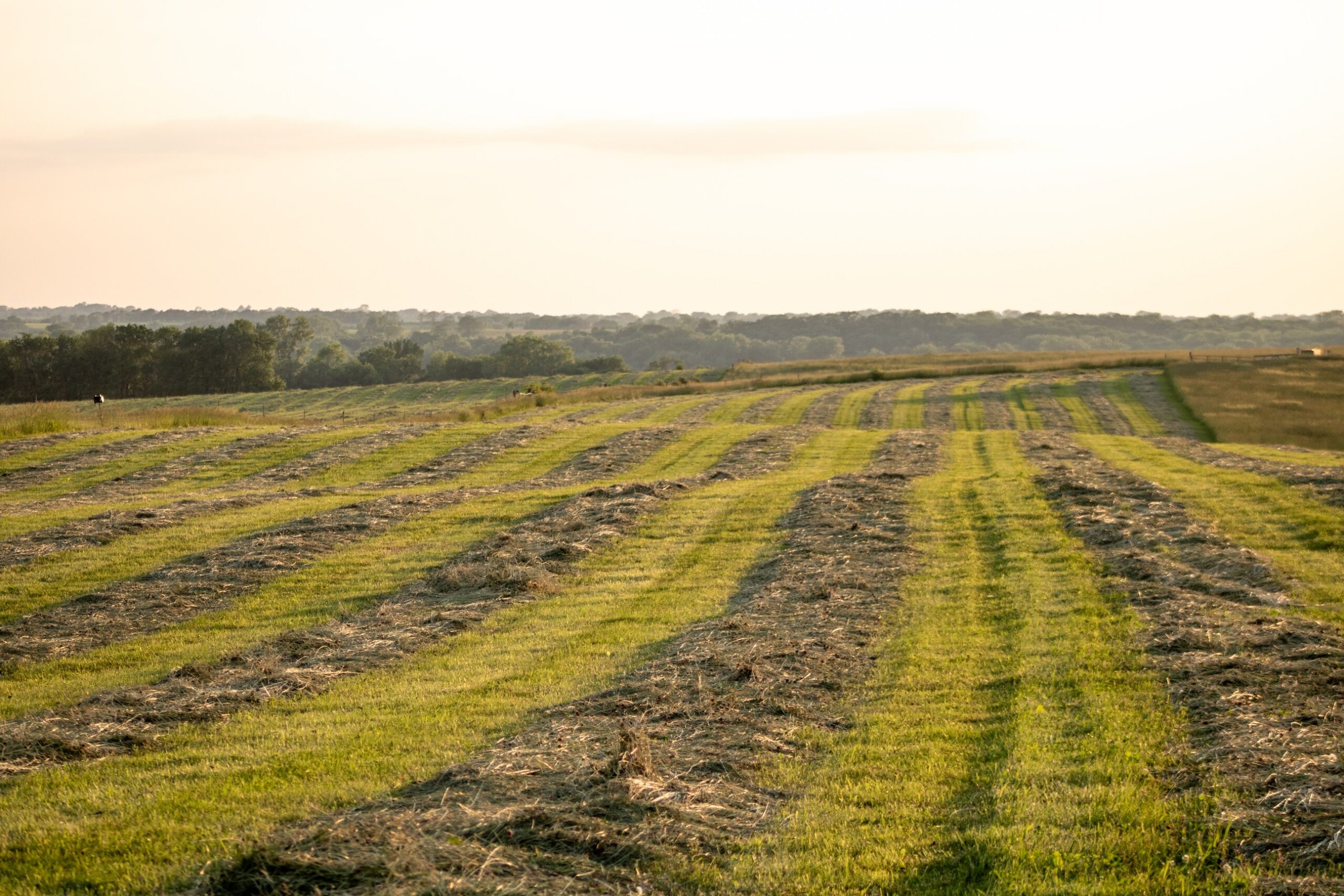
A 288-acre field in central South Dakota carried full input costs every year and lost 10% to 20% of its acres to drown-out in most of them. Wet years ran closer to 25%.
The ground had yield potential to be productive and resilient but how to get there.
The producer kept farming it because the field performed when the weather cooperated. Then he priced it a different way: realized return across wet and dry years, instead of yield potential in a good one.
What the $155-per-acre budget leaves out
On a clean-year budget, the field pencils at $155 per acre. At 170 bushels and $4.00 corn, that’s $680 per acre in revenue against roughly $525 in inputs.
That budget assumes every acre reaches harvest.
By the time standing water shows up, most of the $525 is already spent. Seed’s in the ground, fertilizer and chemical are out, rent’s paid. A drowned acre carries close to full cost and returns nothing, so every lost acre comes straight out of what the surviving acres earned.
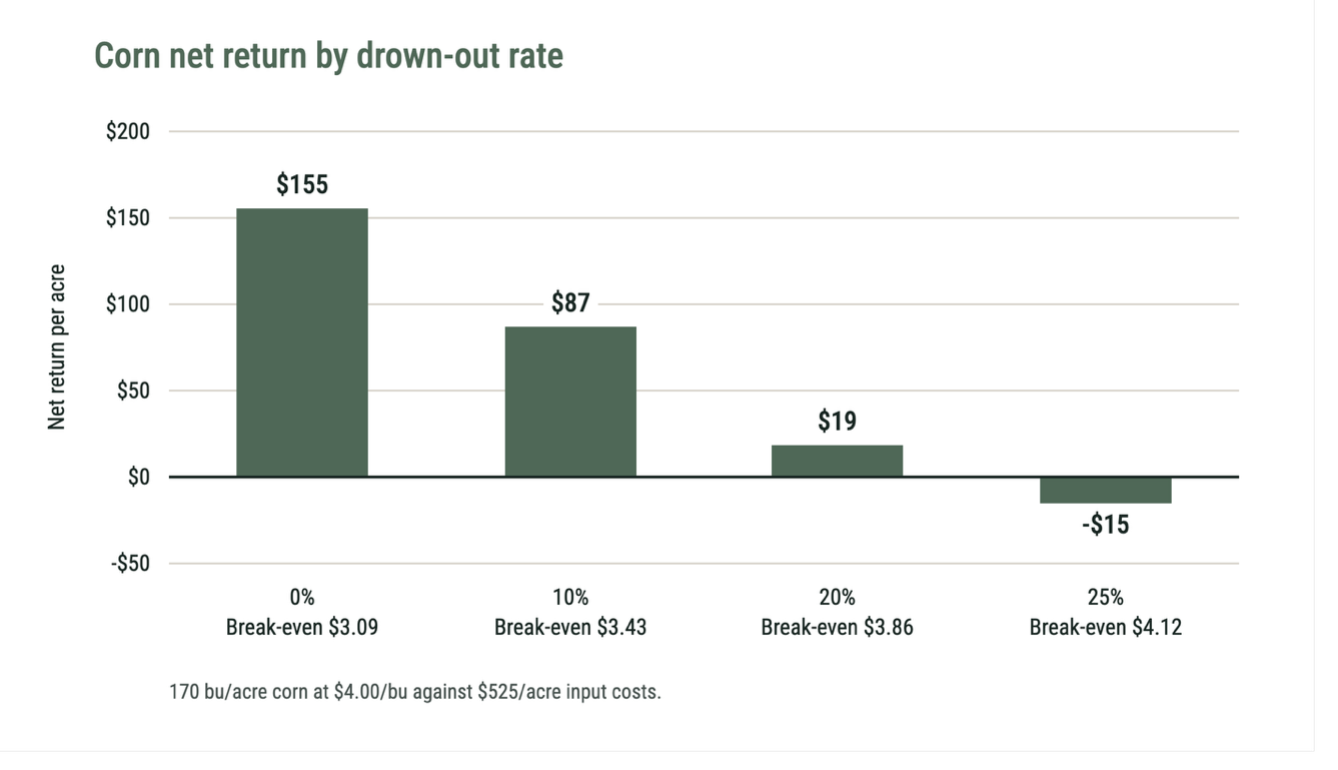
At 0% drown-out, the field breaks even at $3.09 corn. At 25%, it costs $4.12. Water alone moves the breakeven by a dollar.
Converting the field to hay
The operation already ran corn, soybeans, alfalfa, grass hay, cover crops and cattle, so the producer had a use for forage and a market for it on the same balance sheet.
He seeded all 288 acres to a diverse perennial blend for hay.
Through AgSpire, the conversion qualified for a $120-per-acre seed incentive and a $40-per-acre cattle premium. That’s $160 per acre in one-time support against establishment costs of roughly $110 per acre: $75 for seed, $35 for planting and rock rolling.
The incentives covered establishment but whether the change provided profitability long term came down to how the stand produced.
What happened in year one
First-year production came in at 1,550 bales at roughly 1,600 pounds each. That’s 1,240 tons, or 4.31 tons and 5.38 bales per acre. At $80 per bale, the crop was worth about $124,000, roughly $100 per ton.
The stand took no drown-out.
After seed, fertilizer, planting, rock rolling, rent, haying and baling, and with program payments counted, the field returned about $51,900. That’s $180 per acre.
Establishment costs and program payments are both one-time items. At the same production level, the established stand projects roughly $130 per acre per year.
Breakeven on the established stand is 3.75 bales per acre. It made 5.38. Yield can drop by nearly a third before those acres stop covering their costs.
One year doesn’t settle it
One season doesn’t validate a cropping change, so we predicted the perennial stand out 5 years against a 3-year corn, 2-year soybean rotation on the same acres to get a better look at the resiliency and profitability of the stand.
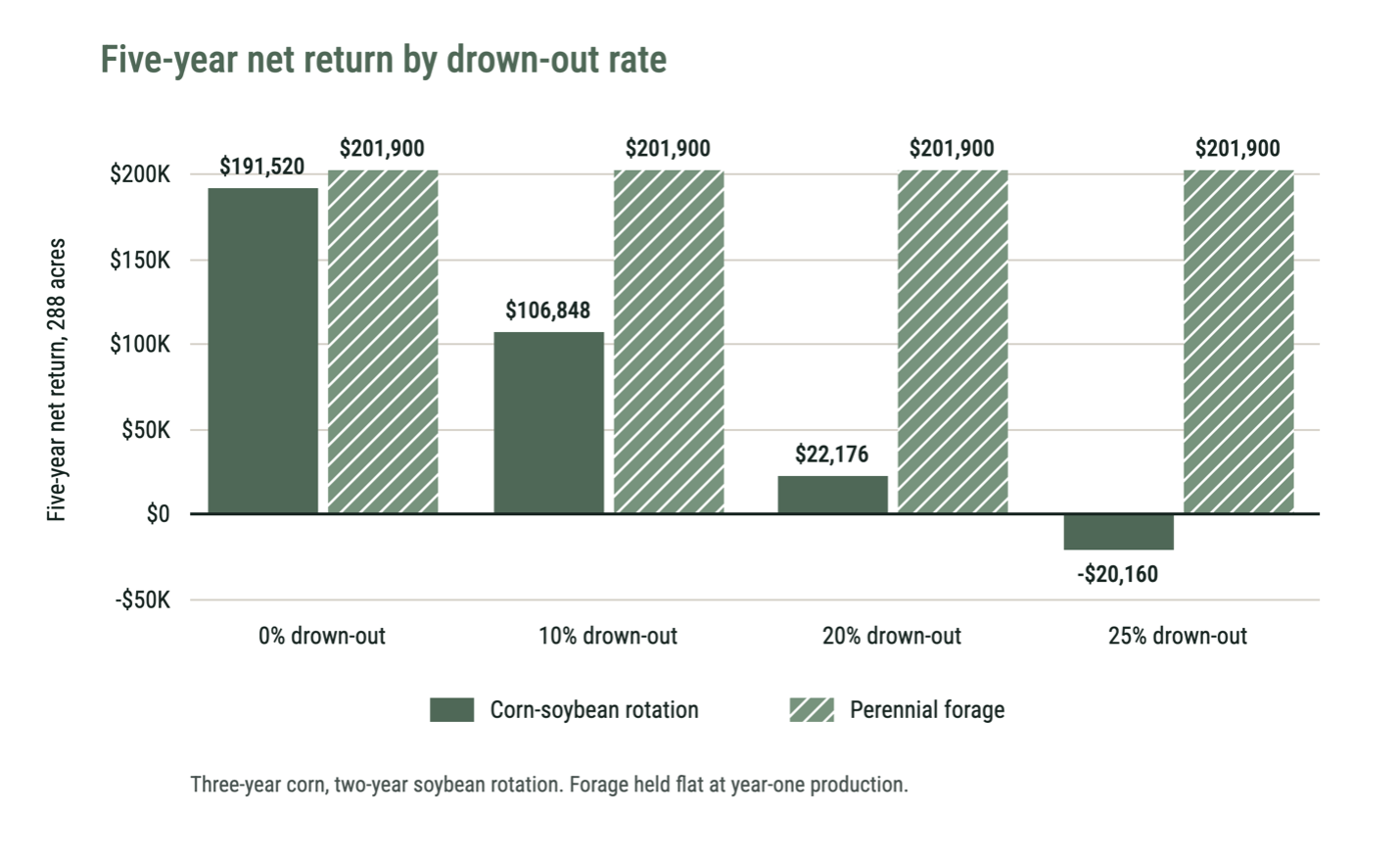
Across 5 clean years, the two systems land close. Perennial forage clears the rotation by roughly $10,000 on the whole field, and part of that margin is the one-time program payment.
This field hasn’t delivered 5 clean years. At its historical 20% drown-out rate, the rotation projects $22,176 over 5 years against $201,900 for forage. That’s a spread of nearly $180,000 on 288 acres.
Run the math on the acres you actually farm
At 170-bushel corn and $4.00 per bushel, these acres looked like a $155-per-acre field. Apply the 20% drown-out rate and realized return falls to about $19 per acre. That’s a big different when you are looking at profitability.
These numbers describe one field. Soil, drainage, market access and forage demand differ on every operation. The problem is what travels: budget problem acres separately from the rest of the field, and run realized return instead of clean-year potential.
Most operations have ground that sounds like this: a wet spot, a field corner, highly erodible acres, or a quarter that takes full inputs and delivers a full crop only when the weather lines up. Those acres deserve their own math and a different look at how to efficiency plant when looking at profitability and resiliency.
Got acres that aren’t pulling their weight? Call or text 605.675.7255 or visit AgSpire.com/producers, and we’ll look at what the best option is for your operation.
Additional Links
Want to learn about AgSpire >>> Click Here
Want to learn more about what it is like to work with AgSpire>>> Click Here
Check out Alex’s video about being a lifelong steward>>> Click Here