

When a company launches an agricultural sustainability program, the instinct is understandable: study it, adapt it, and move fast. In agriculture supply chains especially, where companies often source the same commodity from an overlapping supply shed, the logic seems right. If it worked for them, it should work for us.
The reality is, it usually doesn’t. A Bain & Company survey of more than 300 large companies found that 98% of sustainability programs fail to achieve or exceed expectations. That number is striking on its own. What it obscures is more important: most of those programs weren’t poorly executed — they were poorly designed for the organization running them.
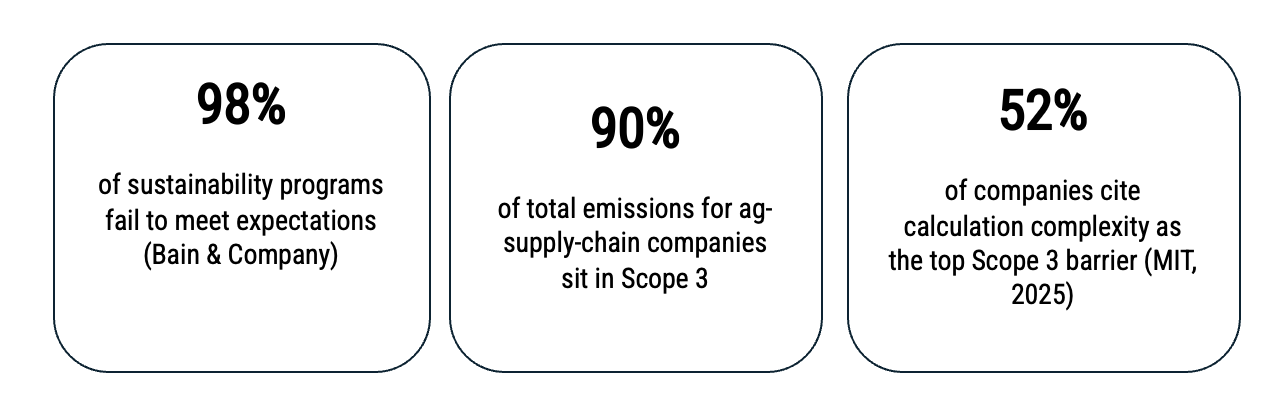
The reason programs fail to deliver real results or scale isn’t random. It comes down to a frequently seen mismatch: the visible features of a peer’s program look similar enough to borrow, while the internal conditions that made it work stay invisible.
The hidden constraints that split programs apart
Two companies can source beef from the same region, share very similar Scope 3 emissions profiles, and still need very different programs. The visible inputs may look alike, but the underlying business drivers and constraints often diverge sharply.
The factors that most shape what a program should look like are rarely the ones featured in a case study. Every company brings its own mix of priorities, the standards and protocols they’re aligned to, investor relations pressures, supply chain de-risking goals, and customer expectations on both the consumer and B2B side. Layer in the realities of agriculture itself, and those priorities ultimately determine what a program needs to deliver, and on what timeline.
No two programs should look alike, because no two companies, their customers, or their constraints ever truly are.
Below that strategic layer, operational constraints pull programs further apart:
Risk tolerance. Some organizations have a higher tolerance for the uncertainty inherent in programs, where results take time to materialize, and early-stage data is directional rather than definitive. Others need defensible numbers on a shorter horizon. The right verification approach is entirely different for each.
Existing supplier relationships. A company with direct relationships and high traceability in their supply-shed can design a very different engagement model than one that operates in an untraceable and segregated supply chain. The engagement approach that generates enrollment in one scenario creates friction in the other.
Internal capacity. A 2025 MIT survey of sustainability professionals found that 39% of companies cite limited internal expertise as a top barrier to Scope 3 work, and 32% cite the high cost of measurement tools. A program designed around the assumption of robust internal capacity will stall in organizations that don’t have it, regardless of how well it worked elsewhere.
What’s actually flexible, and what companies don’t realize they can adapt
The instinct to copy a peer’s program often assumes that major structural decisions, like the MRV platform used, or the use of an MRV platform, the protocols used, the supply chain engagement model, the funding structure, are fixed requirements rather than design choices. They’re not. More of a program’s design is adaptable than most corporate sustainability teams realize.
Verification approach, producer engagement strategy, how a program is funded, and how rigorous outcomes are quantified can all be calibrated to what a company’s specific business objectives are. One area where many teams find themselves at a crossroads is MRV. It’s worth keeping in mind that platform vendors naturally have an incentive to promote more complex solutions, and the idea that more rigorous quantification is always the better choice can be easy to absorb, especially when it seems like what others in the space are doing. But the right level of precision is determined by what your unique reporting obligations require, not by what someone else chose.
Adding unnecessary complexity disguised as rigor without a clear business reason is one of the most common ways a program becomes too expensive to sustain and scale.
Program design has to start with your own variables
The companies that generate real outcomes and build scalable agricultural sustainability programs tend to share a common starting point: a strong awareness of their own situation before looking at what anyone else has done. What is the commodity of focus? What reporting obligations are we operating under today, and where are those likely to go? What does our supply chain make feasible? What is the budget available? What are the KPI’s or metrics most relevant to internal stakeholders?
That process takes longer than adapting a template. It also produces something a template can’t: a program designed specifically to what the organization can actually deliver and build over time. Of all the companies that have now set validated science-based targets globally, very few have FLAG targets that directly address agricultural supply chain emissions. The gap isn’t a reflection of low intent. It reflects how hard it is to design agricultural programs that genuinely fit the organization behind them, and the cost of finding out too late that a borrowed design doesn’t.
The question worth asking before adopting someone else’s program architecture is not whether it worked for them. It’s whether the conditions that made it work for them exist in your organization. More often than not, the honest answer is not entirely. That gap is where program design should begin.

If you’re asking these questions, you’re already ahead
Most sustainability teams reach the program design stage already carrying a version of these questions. They’re the right ones to ask, and they don’t have to be answered alone.
What does this program actually need to produce for our business, and are we designing that, or for what was common practice somewhere else?
Do our internal reporting timelines and leadership expectations match the way this program is structured?
How can we better serve our consumers? What would they like to see?
Are we buying more measurement complexity than our reporting obligations actually require?
Is our supply chain engagement model built for how we operate today, or borrowed from one that looks similar on paper?
Are there funding mechanisms and program structures available to us that we haven’t considered because no one has surfaced them?
A good program designer doesn’t hand you a template. They work through these questions with you and build a program around what comes out of them. That’s the difference between a program that fits your organization and one that fits someone else’s.
Sources: Bain & Company sustainability program survey (300+ companies); MIT State of Supply Chain Sustainability Report, 2025; Science Based Targets initiative, 2026; Deloitte / 3Degrees scope 3 analysis for food and beverage manufacturers; WBCSD Scope 3 MRV Guidance for Agriculture and Food.
Additional Links
Want to read more about AgSpire Programs? >>> Click Here
Want to learn more about our services? >>> Click Here