Part 1
By Derek Ver Helst, Senior Conservation Agronomist, AgSpire
AgSpire helps producers implement conservation practices on their operations through various, voluntary, incentive-based programs. When learning about the programs, producers will ask about the viability of the practices, their potential economic impact, and if the changes can realistically be implemented on their own operations.
Background
We know firsthand there are many trials and tribulations with changing practices in an operation. During the 2025 growing season, Derek Ver Helst, Senior Conservation Agronomist with AgSpire worked with a producer who wanted to convert a 5-acre pasture that had been overrun with smooth brome. The field is a small triangle section of pasture that the producer wants to square off. The goal was to convert the pasture back to native tall grass prairie, add trees for wildlife habitat, and introduce native flowers for pollinator habitat.
Over the course of the summer, Derek documents the progress in the hopes of inspiring and providing ideas for projects anyone can undertake on their own operation. This is the first series that will document progress throughout the season, and will focus on field preparation, planting, germination, and maintenance.
Field Preparation
The first step in the process was prepping fields for planting. The producer sprayed 9 ounces per acre of Plateau along with 32 oz per acre of glyphosate. Class Act Ng, a combination of Nonionic surfactant and Ammonium sulfate, was added to the tank at application to assist in the application. In most cases, glyphosate would be the only chemical used, but smooth brome is developing a resistance to glyphosate (a whole other complex issue). Plateau was added to the mix to help control the cool season smooth brome.
With the combination of chemicals in the tank mix, the producer got a burndown of the field without residual chemical effects on the native seed being planted. It is important to note that if this field had more broadleaf weeds a chemical such as 2,4-D would have been needed to control the unwanted species. When making a native seed plant, it is important to eliminate all competition from undesirable species so that seeds can thrive. But with the use of 2,4-D there is a residual left in the soil that can damage native seeds, and prohibit germination, if not plant outside a 10-day plant back period.
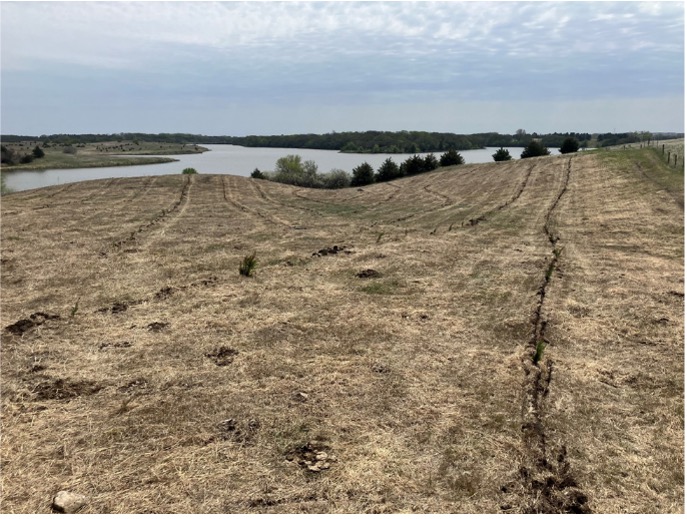
The photo, taken by Derek, shows the field after it had been sprayed, planted with the native seed mix, and tree rows planted. The season started dry but got good precipitation after the plantings.